Design it. Solve it. Get it specified.
HVAC Builder is a browser-based engineering tool for custom HVAC systems — air handlers, chillers, condensing units, cooling towers, heat recovery, VAV terminals — assemble in 3D, solve the real thermodynamic balance, simulate a year of real weather, and scale it up to a whole building room by room, machines coupled to each other. And if you make the equipment, this is where engineers select it: publish your systems and components free, and every selection puts your product in front of the person sizing the job.
Open the builder — free Pricing
Real physics, no black box
ASHRAE psychrometrics, IAPWS-IF97 water properties, AHRI 540 compressor maps, CoolProp refrigerant data, ε-NTU coil models. The solver reports its convergence — and refuses to hand you a silent partial result. How it reads against published data →
Any topology, not templates
DX circuits, water loops, air- and water-cooled chillers, remote condensing units, cooling towers, two-stage evaporative, heat-pipe wraps, heat recovery, face-and-bypass — connect typed air/water/refrigerant ports any way the physics allows, and the graph solver figures out the rest. Every system carries a category — rooftop, split, air handler, chiller, condensing unit, fan coil, evaporative, recovery, plant, unit cooler, or one of your own — and any saved or published system drops into another design as a single block: a system of systems, solved flat.
From design point to 8,760 hours
One click pulls a real typical meteorological year for 50 major cities — measured data from PVGIS, the European Commission's Joint Research Centre. Load-following control staging, compressor modulation, economisers and demand-controlled ventilation, humidity control, VAV terminals, heating and cooling modes — a full annual simulation takes seconds.
How it works
Simulate the whole building
The Simulate tab scales it up: rooms as blocks — floor area, envelope, internal gains, solar aperture — and machines beside them, connected port to port: a machine's outlet to the rooms it serves, their return to its intake, a chiller's water to an air handler's coil, a VAV box on every room. One run solves every machine against the weather year, one hour behind the other where they couple: per-room comfort with unmet hours, humidity and temperature histograms, per-system energy, building totals. Solar gains come straight from the weather data's irradiance. Engineers →
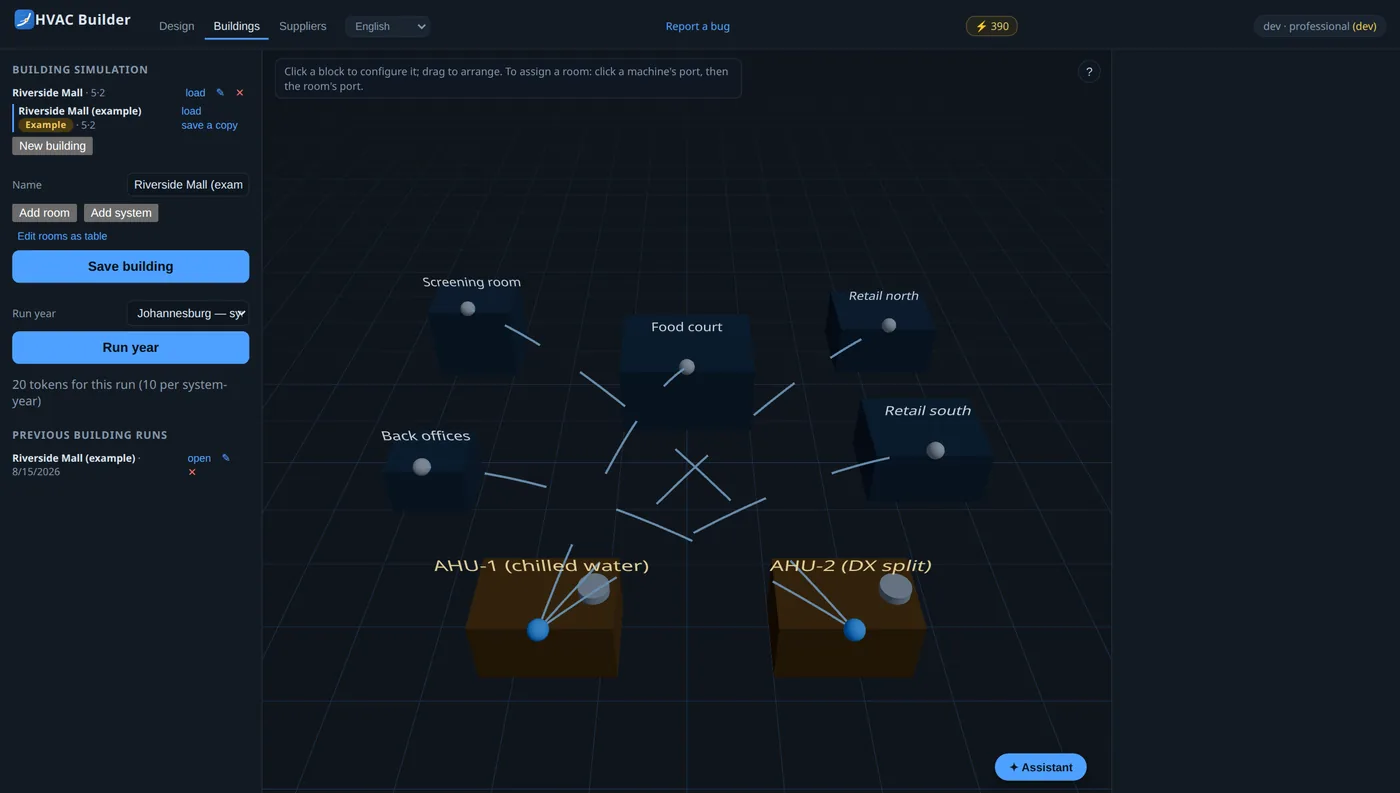
Try it before you build anything: the worked example buildings — a mall, an edge data centre, a hotel, an office floor, a primary school, a logistics hall, a telecom shelter, a campus plant, a cleanroom, a supermarket, a hospital suite, a VRF office floor, an apartment block and a clinic: 17 buildings and 36 machines, from a district chiller plant to a cold-store condensing unit — run on every plan including Free, 3 times a day. Cases →
Equipment from suppliers
Suppliers publish real machines and components on HVAC Builder — every page carries the manufacturer's own data, solved by the same engine you design with. Browse them, open one in the builder, and request a quote with your design attached.
Heat-pump dryer, 20 kW class
A closed-loop heat-pump dryer: a DX coil that takes the water out of the drying chamber's own 55 °C air, the condenser in the same stream reheating it, a circulation fan — on a Copeland ZWD81KBC digital scroll (R134a, rated to 85 °C condensing) with its 10–100 % modulation declared. Nothing leaves but condensate. Run humidity-led in a building: steered on the chamber's humidity ceiling alone. Published as an example; the figures below are solved from this model.
Water-source heat pump plant, 30 kW class
A heat pump whose source is a data centre's cooling loop: a coaxial evaporator on the 18 °C return water a CRAH sends back, a Danfoss VZH052 inverter scroll from the catalog with the maker's eighteen published speed steps setting its part-load power, and a coaxial condenser lifting a heating loop to 54 °C — the arrangement Seattle's Westin Building Exchange and the offices next to it run. The source is warm all year, so the machine works over a 40 K lift instead of an air-source unit's 50–60 K in winter, and the chiller behind it has that much less to reject. It serves no room; it holds its leaving water for whatever draws on it. Published as an example; the figures below are solved from this model.
VRF outdoor unit, 33 kW (12 HP): inverter + fixed scroll bank
A 12 HP-class VRF outdoor unit drawn as the frames of that size are built: a catalog inverter scroll and a catalog fixed-speed scroll on one circuit — a bank, the fixed machine running flat out as base load and the inverter trimming — behind a condenser declared from a 12 HP cabinet (980 × 1630 × 800 mm, 11 500 m³/h). Modulated to 33.5 kW the way the control runs it, it draws a maker's published power input within −9 to +3 % from 25 to 39 °C outdoor, the miss at the cool end, where a real unit runs its fixed scroll harder than the staging rule does. Published as an example; the figures below are solved from this model.
ACT WAHX 12-4 wrap-around heat pipe, 1473×1100 face (sized for 4 m³/s)
Heat-pipe wrap, 1473 × 1100 mm face, 4 rows at 12.0 fpi.
ACT WAHX 12-6 wrap-around heat pipe, 1473×1100 face (sized for 4 m³/s)
Heat-pipe wrap, 1473 × 1100 mm face, 6 rows at 12.0 fpi.
ACT WAHX 12-8 wrap-around heat pipe, 1473×1100 face (sized for 4 m³/s)
Heat-pipe wrap, 1473 × 1100 mm face, 8 rows at 12.0 fpi.
Browse all published systems → Browse published components → Browse suppliers →
Ask the suppliers who can actually build it
Once a design solves, request quotes straight from it. HVAC Builder reads the equipment out of the graph — kinds, duties, refrigerants — and matches it against what each supplier has declared it can manufacture, in the regions you pick. Every matched supplier receives one request covering just the parts it can supply, with the specification attached. Quote a whole system, a few selected components, or an entire building in one go — 5 requests a day on every paid plan. Sharing the openable model is opt-in; the written specification always travels with the request.
Let AI do the drafting
HVAC Builder ships an MCP connector: point any AI agent that speaks MCP at hvacbuilder.app/api/mcp as a custom connector — you sign in when it asks, with no key to paste. Describe your requirements and it designs a system, or composes one from published machines and your own; solves it; fetches a real weather year and simulates it; models a building room by room and runs it; saves what it made to your account — and, if you are a supplier, publishes your range and reads your leads.
Prefer to stay in the app? The built-in assistant chats right in the builder — it reads your design, modifies it, solves and simulates on request. Bring your own AI provider key for unlimited chat, or use the platform's, metered by simulation tokens.
Pricing
| Free | Starter | Professional | Business | Enterprise | |
|---|---|---|---|---|---|
| Price | $0 | $15/mo First month −15% | $39/mo First month −30% | $79/mo First month −45% | On request |
| Saved systems | 3 | 25 | 100 | 250 | ∞ |
| Annual simulation | — | ✓ | ✓ | ✓ | ✓ |
| AI assistant | — | ✓ | ✓ | ✓ | ✓ |
| Building simulation | — | — | ✓ | ✓ | ✓ |
| Simulation tokens | 250/mo | 1 000/mo | 4 000/mo | 10 000/mo | 30 000/mo |
| Extra tokens | — | 500 for $10, never expire | |||
| Reports | watermarked | HTML + PDF | HTML + PDF | HTML + PDF | HTML + PDF |
| API keys + MCP | ✓ | ✓ | ✓ | ✓ | ✓ |
| Workspace seats | — | — | — | 3 included, $15 each | 3 included, $15 each |
Compute tokens meter everything: a point solve costs one token per ten components, so most machines are one, and a simulated year of that system costs ten times what solving it once does. There is no size cap — a bigger system costs more tokens rather than being refused. Prices in USD; checkout can present your local currency automatically. Interface in English, Deutsch, Français, Español, Italiano, Polski, Nederlands, Svenska, Norsk, Suomi, 中文 and 日本語.
Built on an open ecosystem
Component vendors list real equipment engineers can select — every selection is a lead. System suppliers publish ready-made machines that appear right when a design matches their range. Engineers → Vendors → Suppliers →