From room loads to a quoted machine, one tool.
You design or specify HVAC for real buildings. HVAC Builder takes you from envelope and internal loads to per-room comfort and per-system energy, solved with real thermodynamics against a real weather year, then puts suppliers' actual machines next to your numbers, one quote request away.
Open the builder — free The worked cases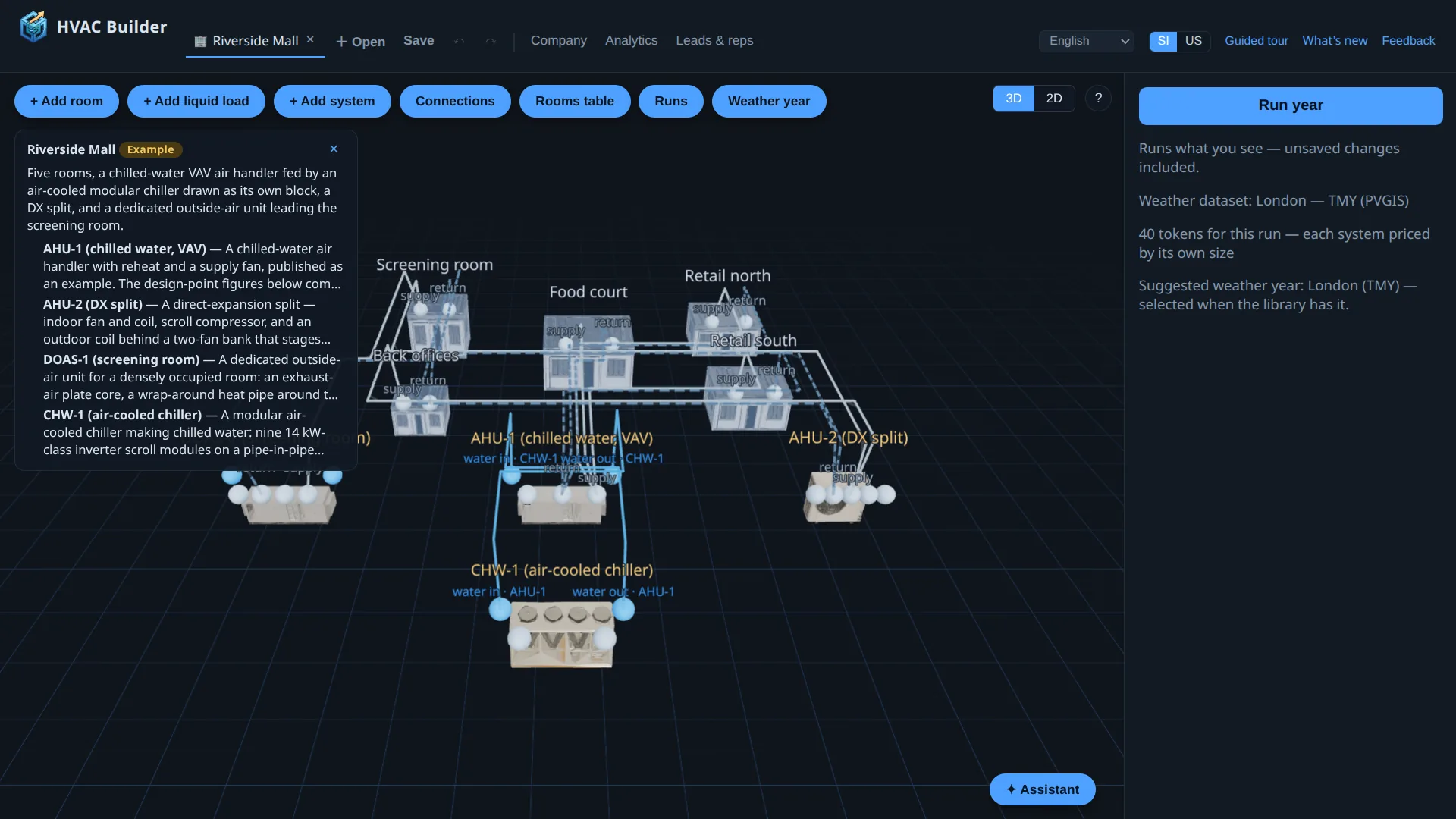
Whole-building simulation
Draw rooms as blocks: area, envelope UA, day and night gains, solar aperture, setpoints, a humidity ceiling. Connect machines to them port to port, supply, return, a VAV box per room, and machines to each other, a chiller's water to an air handler's coil. Run the year: unmet hours, humidity and temperature histograms, and energy per room and per system.
Machines you can trust, or open up
Use suppliers' ready-made systems as sealed blocks, or build your own, air handlers, chillers, condensing units, cooling towers, from compressors with AHRI 540 maps, real coil geometry, fans and pumps on their curves, and evaporative media. Nest one system inside another and it solves as one. Same solver either way; no brochure numbers.
Order from the numbers
Component selections and duty-matched supplier systems carry one-click quote requests. Your RFQ arrives at the vendor with the design attached; sizing conversations start half-finished.
One request, every supplier who can actually build it
Solve a system and you can ask the market to price it without hunting for anyone. HVAC Builder reduces your solved design to what it actually requires, component kinds, duty, refrigerants, and matches that against what suppliers declare they can build: capacity envelope, regions, certifications. You see the matched list before anything is sent, choose who it goes to, and send once.
Quote at the grain that suits the job: the whole system, a subset of components you tick off in the builder, or a whole building, where each distinct machine is matched separately and every supplier receives one request covering just the parts they can supply, with quantities. Ask in several regions at once. Your design's spec travels with the request so the reply is a real number; the openable model only goes if you tick the box. Every request you have sent is listed in the builder, with who it reached.
A workflow that matches how projects actually run
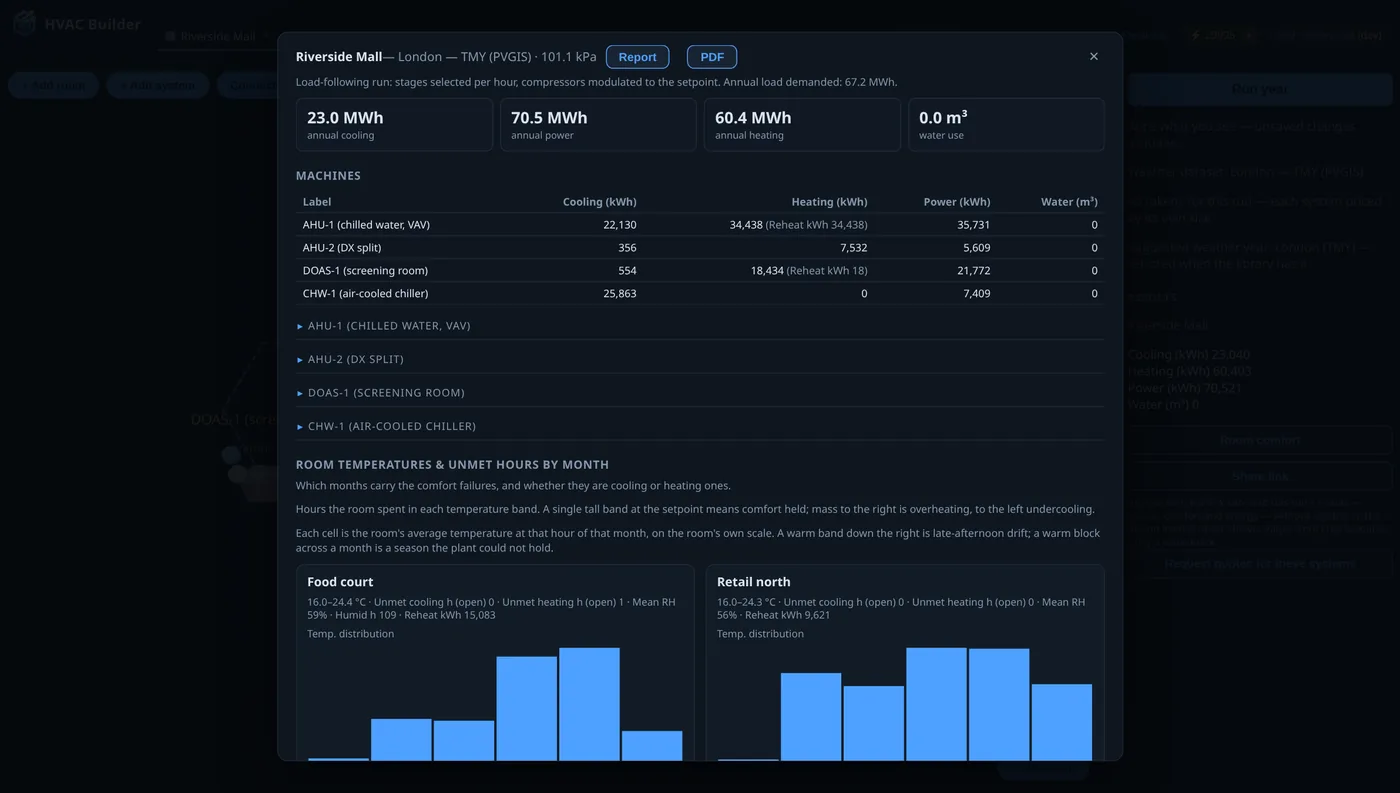
Defensible numbers
Every result comes from published physics: ASHRAE psychrometrics, IAPWS-IF97 water properties, AHRI 540 compressor maps, CoolProp refrigerant data, EnergyPlus-published correlations, and the solver reports its convergence instead of handing you a silent partial result. Estimates, clearly labeled as estimates, that you can defend in a design review. Every source, linked. How the model reads against published data.
Find a machine that fits your building
Suppliers publish complete machines here, each with its own public page, its manufacturer's data, and performance solved by the engine you design with. Filter by capacity and market, open one in the builder, drop it into your building model, and see how it behaves in your climate before you ask anyone for a price.

Start with the building you have on your desk.
The worked examples run free on every plan; your own building runs on the same solver.
Open the builder — free